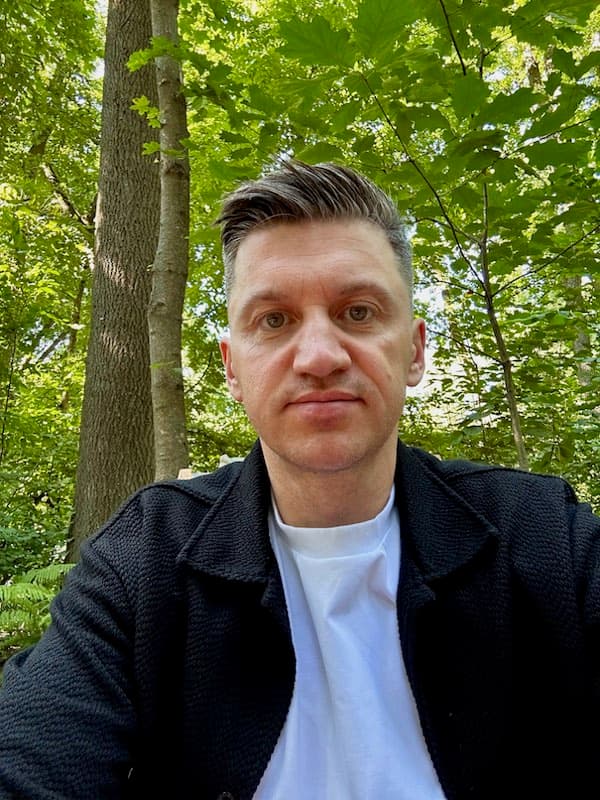
By Vadym Lobariev, founder of MindHunt — 20+ years in recruitment across Ukraine, Europe, and globally.
Quick summary
Ukraine still has 300,000+ IT professionals and deep expertise in engineering, finance, and operations. AI sourcing handles the mechanical parts — LinkedIn scanning, candidate scoring, personalised outreach — so recruiters can focus on what actually closes hires: conversations, judgment, and trust. The result: a targeted longlist in hours instead of days, with response rates that manual outreach can't match.
In 2006 I needed to find 30 CFO candidates across Ukraine.
I opened the Kyiv Business Directory.
Not Google. Not LinkedIn. A physical book.
90+ cold calls. Long hold music. "He's not available." "She left the company." "This number is no longer in service."
Today — the same search takes minutes. Not because I got faster. Because the tools finally caught up.
I'm Vadym Lobariev, founder of MindHunt recruitment agency. We've been filling vacancies in Ukraine, Europe, and globally since 2011. And for the past two years, we've added AI to every stage of our process.
This article explains exactly how that works — and why it matters if you're looking to hire in Ukraine.
Why Ukraine Is Still a Strong Hiring Market
Before we get into the process: yes, companies still hire in Ukraine. Actively.
According to Statista, Ukraine's IT services market is on a growth trajectory in 2025, fuelled by a highly skilled workforce and competitive salary levels compared to Western Europe and North America.
Ukraine has one of the largest pools of tech talent in Eastern Europe — over 300,000 IT professionals according to market research. Beyond tech, Ukraine has deep expertise in engineering, finance, operations, sales, and management roles.
The war changed the market. It didn't kill it.
Companies that stopped hiring in Ukraine in 2022 are quietly returning. Those who never left are ahead.
If you need to fill a vacancy — specialist, manager, or C-level — Ukraine is still where you find strong candidates at reasonable compensation levels. Contact us if you want to understand what the market looks like for your specific role.
What "AI Recruitment" Actually Means (And What It Doesn't)
Let me be direct: AI doesn't replace recruiters. It removes the parts of recruiting that should never have been done by humans in the first place.
The parts that kill time without requiring judgment:
- Searching thousands of LinkedIn profiles manually
- Copy-pasting candidate data into spreadsheets
- Sending the same outreach email to 200 people with only the first name changed
- Tracking who replied, who didn't, who bounced
I spent 20 years doing exactly this. Not because I liked it. Because there was no other way.
There is now.
At MindHunt, we use an AI-powered sourcing platform that handles the mechanical parts of recruitment — so our recruiters can focus on what actually closes hires: conversations, judgment, and trust.
Our Actual Recruitment Process (Step by Step)
Step 1: We Define the Search Map Before We Search
Most recruitment agencies start searching immediately. We don't.
Before any AI tool touches a vacancy, we spend time with the client understanding:
- What does this person actually need to accomplish in the first 90 days?
- Which companies in Ukraine would have someone with this background?
- What's the realistic compensation range for this profile?
- What makes this opportunity worth leaving a stable job for?
This "search map" stage takes 1–2 days. It saves weeks.
According to SHRM research, a bad hire costs companies 50–200% of the role's annual salary. Most bad hires happen because the brief was wrong — not because the candidate was wrong.
We get the brief right first.
Step 2: AI Sourcing — Finding Candidates at Scale
Once we have the search map, we use our AI platform to source candidates.
The platform scans LinkedIn and professional databases, finds profiles matching our criteria, and — this is the key part — scores each candidate against the job requirements.
Not every person with "Python" on their profile is a Python developer. Not every person with "Sales Director" in their title has closed enterprise deals. The AI scoring filters noise and surfaces signal.
For a typical vacancy, we go from thousands of potential matches to a targeted list of 50–150 scored candidates within hours.
Compare that to manual search: a good recruiter doing this by hand takes 3–5 days to build a list half that size.
Step 3: Personalised Outreach — Not Templates
This is where most recruiters fail.
I've received thousands of messages that start with "Dear [First Name]" — meaning someone forgot to replace the merge tag. Or messages that describe a role completely unrelated to my background.
Candidates notice. They don't reply.
Our AI platform helps us personalise outreach at scale — referencing specific experience, recent projects, or role transitions visible in the candidate's profile. The message feels like it was written for them. Because it was.
Response rates improve when outreach is relevant. This is not a surprise. But doing it manually for 150 candidates is impossible. With AI, it's standard.
Step 4: Multi-Channel Follow-Up (Including Telegram)
Ukraine has its own communication culture.
Email works for some candidates. But many Ukrainian professionals — especially technical specialists — respond faster on Telegram. We've had candidates ignore three emails and reply within 20 minutes on Telegram.
Our process includes multi-channel outreach: email first, Telegram follow-up, LinkedIn as backup. We track everything in one place, so nothing falls through the gaps.
Step 5: Human Screening and Interview Process
This is where AI stops and recruiters take over completely.
After candidates respond, our team conducts structured screening interviews. We assess:
- Actual skill level vs. what's on the CV
- English proficiency (for international roles)
- Motivation — why they'd consider leaving
- Soft skills and cultural fit for the specific client
We use what we call a "trial close" technique: before sending a candidate to a client interview, we confirm they would genuinely accept an offer at the expected salary range. This prevents wasted time on both sides.
Our clients receive a shortlist of 3–5 candidates per vacancy — pre-screened, motivated, and realistically hireable.
Step 6: Offer Management and Counter-Offer Prevention
The offer stage is where hires die.
A candidate accepts an offer. Their current employer counter-offers. Suddenly the hire is gone.
We manage this proactively. Throughout our process, we track each candidate's relationship with their current employer, their real reasons for considering a move, and what it would take for them to accept without hesitation.
When the offer comes, candidates are prepared. Counter-offers rarely work on candidates who are genuinely ready to move.
According to LinkedIn's Global Talent Trends research, effective candidate relationship management during the offer stage significantly reduces fall-through rates — something that purely automated tools cannot address.
What This Process Looks Like in Practice
Here's a real example structure (details changed for confidentiality):
- Role: Head of Operations for a European company with a Ukrainian team
- Timeline: First candidates presented within 5 business days
- Shortlist: 4 candidates after full screening
- Result: Offer accepted by candidate #2. Still with the company 18 months later.
The AI handled sourcing and initial outreach. Our recruiters handled everything that required judgment.
This is the combination that works.
Who We Work With
MindHunt works with:
- Founders and C-level executives who need to fill important positions without distraction
- Companies hiring in Ukraine from abroad — US, UK, EU — who don't have local market knowledge
- Growing companies that need a reliable recruitment partner, not a one-off placement agency
We offer two main engagement models:
- Recruitment Subscription — for companies with ongoing hiring needs. Predictable cost, continuous pipeline of candidates.
- Headhunting Package — for single critical roles, especially C-level and department heads.
Both are built on the same AI-assisted, human-closed process described above.
The Honest Part
AI makes us faster. It doesn't make us better.
What makes recruitment work is still what it's always been: understanding what a company actually needs, finding people who are genuinely interested, and building enough trust that both sides say yes.
The Kyiv Business Directory is in storage somewhere. I don't miss it.
But I've also seen AI-only recruitment fail spectacularly — automated messages sent to the wrong people, "matched" candidates who had none of the required skills, offers made to candidates who were never genuinely interested.
The combination — AI speed, human judgment — is what closes vacancies.
That's what we do at MindHunt.
Related guides for hiring AI engineers
- How to Hire an AI Engineer in 2026
- AI Engineer Salary 2026: US, Europe & Ukraine Compared
- AI Engineer Interview Questions: 15 to Ask (With Red Flags)
Hiring AI engineers specifically? See our AI engineer recruitment service — every candidate is technically screened by a Claude Certified Architect.
Ready to Fill Your Vacancy?
If you have an open position and want to understand how our process would work for your specific role, get in touch.
We'll start with a short call — 20–30 minutes — to understand the role, the search map, and whether we're the right fit for each other.
No pitch deck. No vague promises. Just a conversation about what you need.
Written by
Vadym Lobariev
MindHunt is an AI powered recruitment firm for founders, C-level and hiring managers who are tired of posting and praying. We execute a proven sourcing process for your hardest roles and show you the work every week — so you can make hires with confidence, not hope.